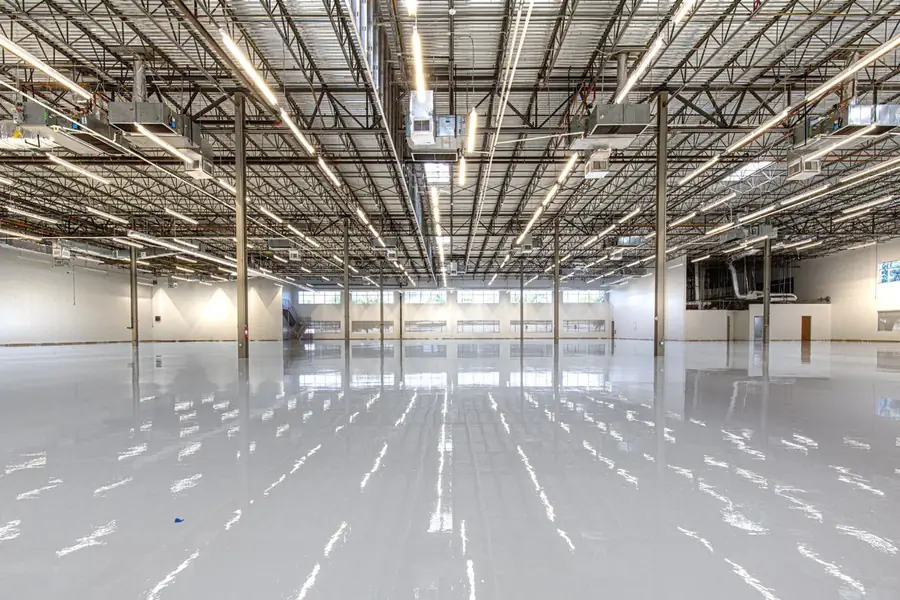
Epoxy flooring in Bismarck ND is a resinous coating system bonded to a mechanically profiled concrete slab. Done properly it is not paint and it is not a kit. It is a three-layer build, typically 20 to 40 mils thick, installed over concrete that has been diamond ground to an open profile so the resin can key into the surface rather than sit on top of it.
That distinction is the whole job. A Bismarck garage floor is the most abused surface in the house: it takes chloride brine off the vehicle from late November to March, it cycles through freeze and thaw at the door line, and it carries hot tyres onto a cold slab. Every failure mode we get called out to look at traces back to bond, and bond traces back to prep.
Epoxy Floors, Concrete Coatings and Polyaspartic: What You Are Actually Choosing Between
Homeowners search for garage floor epoxy, concrete coatings, polyaspartic and epoxy floors as if they were four different products from four different trades. They are four points on one spectrum, and the right one depends on your garage, not on the brochure.
Epoxy
Two-part amine-cured resin. Thick per coat, strong build, good at filling a rough or repaired slab, and the most cost-effective body coat available. Its limitation is temperature: it is best applied above 50 F and most formulations never fully cure below that.
Polyaspartic and polyurea
Aliphatic polyurea chemistry produced from a polyaspartic ester. Cures at temperatures that stop epoxy, returns to service in hours rather than days, and holds colour under UV instead of ambering. Costs more per square foot and gives the installer a shorter working window. Polyaspartic coatings in Bismarck →
Flake and metallic systems
Not separate chemistries, but decorative layers inside the build. Vinyl flake is broadcast into a wet body coat, then encapsulated. Metallic uses pigment dispersed in a clear resin and moved on the floor. Flake density and chip size are decisions, not defaults. Metallic and flake epoxy →
Stains, densifiers and penetrating sealers
Thin-film or no-film options. They colour and harden concrete without building a coating that can delaminate, which makes them the right call on some basement and shop slabs where moisture is a question mark. Concrete staining and sealing →
Why Bismarck Is a Harder Market for Concrete Coatings Than It Looks
Bismarck sits at 1,745 feet on the east bank of the Missouri River and takes about 50.5 inches of snow and 19.05 inches of precipitation a year, with a January mean of 12.8 F and a record low of minus 45 F. That is not a climate a coating survives by accident.
The mechanical problem is chloride-driven surface freeze-thaw. NDDOT keeps roads open with straight salt, salt and sand, and a liquid blend of water, salt and a sugar beet product that stays effective well below zero. Its own numbers explain why the dose is heavy: at 30 F a pound of salt melts about 46.3 pounds of ice, but at minus 6 F it melts only 3.2 pounds. Cold snaps mean more material, and more material means more brine dripping off your vehicle onto the first eight to ten feet inside the garage door.
On bare concrete that brine enters the pore structure, freezes, expands and takes the finished top layer with it. The result is scaling, then spalling, then a pitted parking strip while the back half of the floor still looks new. A continuous, properly bonded coating removes the pore structure from the equation. A coating that is not properly bonded traps the moisture under the film instead, which is worse than leaving it bare.
The second problem is the calendar. Bismarck's cold season runs roughly November 24 to March 4, about 3.4 months, with average highs below 35 F. Epoxy cure time doubles for every 18 F drop below 70 F, so an 8 hour cure at 70 F becomes about 18 hours at 50 F, and below 50 F most epoxies simply do not finish curing. Any contractor telling you a standard epoxy build is fine in an unheated Bismarck garage in January is either heating the space or overselling.
What a Real Epoxy Flooring Job Includes in Bismarck
Moisture and slab assessment
Older Bismarck slabs, particularly in Bismarck's south and central neighbourhoods and across the river in Mandan, were often poured before a vapour retarder under the slab was standard practice. A film-forming coating over a slab with an active moisture drive will blister. We check before we quote a system, not after we install one.
Diamond grinding, not acid etching
Grinding removes the hard, closed laitance layer left by power trowelling and opens a texture the resin can grip. Acid etching does not reliably do that on a hard-troweled slab, and it is the single most common reason a hardware-store finish peels in tyre-shaped sheets.
Crack, spall and joint repair
Scaled areas get cut back to sound concrete and filled with a polymer-modified patch or fast-set mortar. Control joints get treated as joints that still move, because with a Bismarck frost line around 42 to 48 inches the ground under the slab is doing something different in February than it was in July.
Base coat, body coat, topcoat
A primer that penetrates, a pigmented or flake-receiving body coat, and a clear topcoat that carries the wear. Skipping the topcoat is where a cheap quote finds its savings, and it is the layer that decides how the floor looks in year eight.
Written cure and return-to-service times
Foot traffic and vehicle traffic are two different dates, and both move with slab temperature. You should get them in writing, tied to the system installed, before the crew leaves.
Reading a Bismarck Epoxy Flooring Quote
Not one contractor in this market publishes a price, so homeowners arrive at a quote with a national number in their head and no way to test it. Three things explain almost every gap between two quotes on the same garage.
For the full per-system breakdown and what a 576 square foot two-car garage lands at, see the Bismarck epoxy floor cost guide. For the seasonal side of the decision, see the winter install guide.