The Bismarck-Mandan metropolitan area covers Burleigh, Morton and Oliver counties and was estimated at 135,786 people in 2023. Bismarck sits at 1,745 feet on the east bank of the Missouri, Mandan at 1,647 feet on the west, and Lincoln at 1,690 feet on the southern edge, all tied together by I-94, US-83 and the Bismarck Expressway.
It is a small metro by national standards and a big one by North Dakota standards, and the practical consequence for a floor coating contractor is that a job on either bank is inside the same working day. Nobody here should be paying a river surcharge.
Communities We Cover
| Community | County | Population | What typically gets coated there |
|---|---|---|---|
| Bismarck, ND | Burleigh County | 76,981 | State capital, most new build on the north side |
| Mandan, ND | Morton County | 25,061 | Railroad-era core, refinery and rail trades, older slabs |
| Lincoln, ND | Burleigh County | 4,365 | Newest housing stock in the metro, incorporated 1977 |
| Wilton, ND | Burleigh and McLean | Small town | Acreages and detached shops |
| Washburn, ND | McLean County | Small town | Rural shops and equipment storage |
| Center, ND | Oliver County | Small town | Oliver County seat, ag and energy buildings |
| New Salem, ND | Morton County | Small town | West along I-94, ag buildings and home shops |
| Sterling, ND | Burleigh County | Small town | East along I-94, acreage pole barns |
| Hazelton, ND | Emmons County | Small town | South along US-83, larger jobs by arrangement |
| Baldwin, Menoken, Regan, ND | Burleigh County | Rural | Acreage garages and shop buildings |
Bismarck, Mandan and Lincoln each have their own page because their slabs genuinely differ. Bismarck is the volume market and the north-side new build. Mandan is older slabs and industrial work. Lincoln is the newest housing stock in the metro.
Scheduling Around a North Dakota Calendar
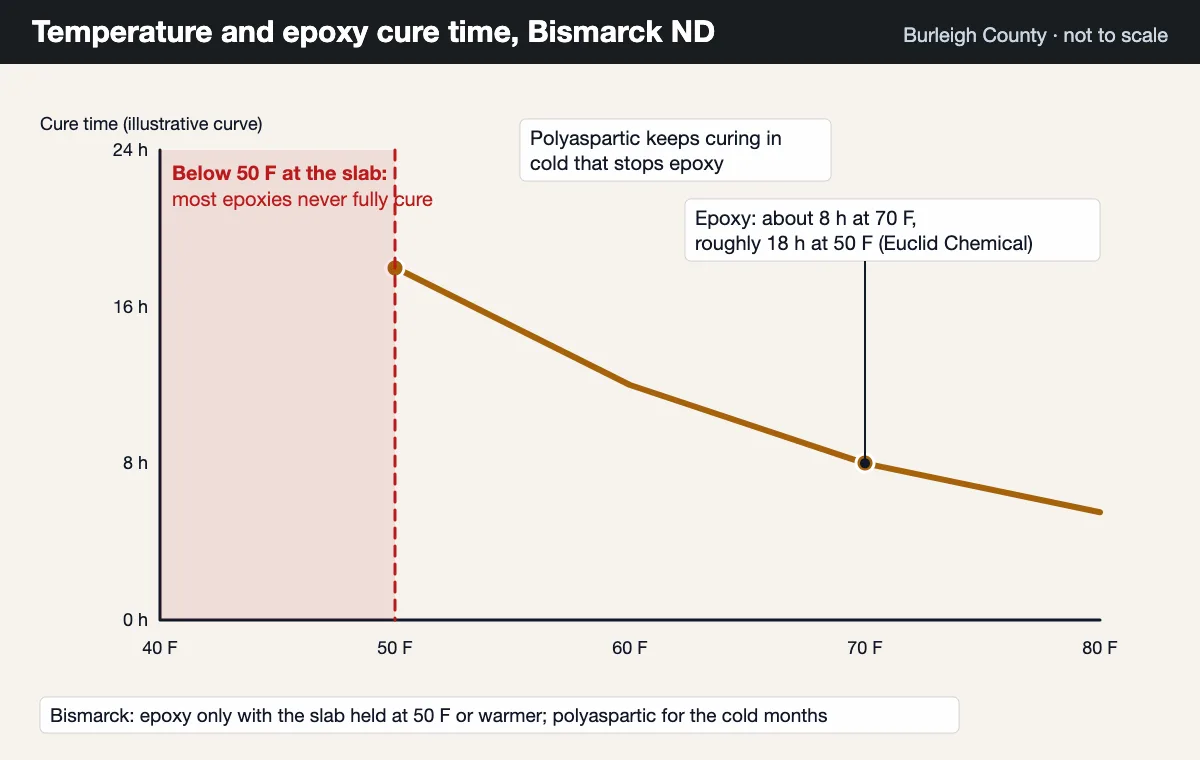
The real constraint on this corridor is not distance, it is the season. Bismarck runs a cold season of about 3.4 months from roughly 24 November to 4 March, with average daily highs under 35 F, and a frost-free window of about four and a half months from mid May to late September.
Standard epoxy work concentrates into that warm window because the chemistry requires it, which means spring and early summer book out first every year. If you want a conventional epoxy build in an unheated detached shop, plan on booking it in late winter for a summer slot.
Polyaspartic is what keeps the rest of the calendar open. It cures at temperatures that stop epoxy and returns to service in hours, which is why it is the default recommendation for cold-season work anywhere in the corridor. The full seasonal breakdown →