Installing a Floor Coating Through a Bismarck Winter
Bismarck spends about a third of the year below the temperature standard epoxy needs to cure. No local contractor site explains what that means for your job, so this page does: the numbers, the chemistry, the salt, and which months take which system.
Two facts decide almost every winter floor coating conversation in Bismarck. Standard epoxy needs a slab at 50 F or above, held through the cure. And Bismarck's cold season runs roughly November 24 to March 4, about 3.4 months, with average daily highs below 35 F and a January average of 24 F high, 6 F low.
Put those together and the answer is not that winter installs are impossible. It is that in winter the building and the chemistry decide the job, and any contractor who skips that conversation is either heating the space or hoping.
The 50 F Rule and Why Cure Rate Is Not Linear
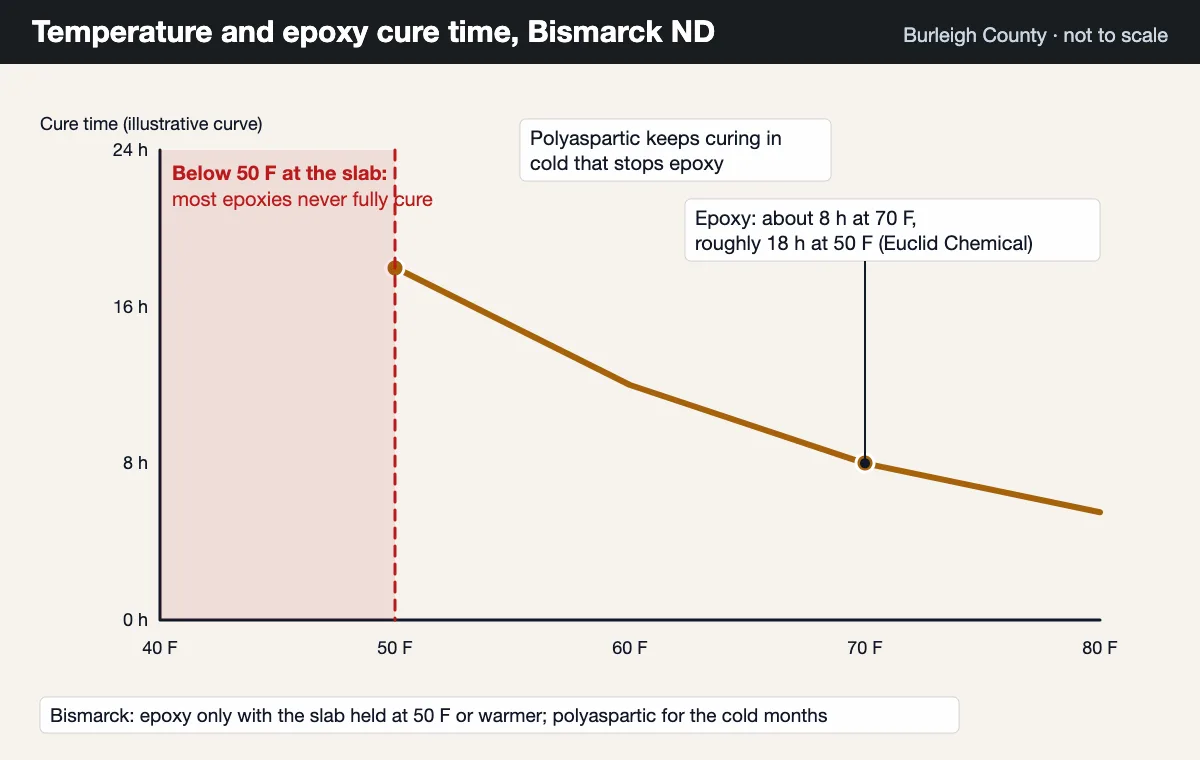
Euclid Chemical, a major coatings manufacturer, publishes three things worth taking literally. Epoxy coatings are best applied above 50 F. For every 18 F drop below 70 F, the cure time doubles. And most epoxies, unless specifically formulated for cold weather, will never fully cure below 50 F.
Their own worked example: an 8 hour cure at 70 F becomes roughly 18 hours at 50 F. Note what that implies. Cold does not simply make a good floor slower. Below the threshold it produces a coating that never develops the physical properties it was designed for, which then fails early, and the failure almost always shows up first where the tyres sit.
Manufacturers also specify conditioning the resin and hardener at 70 to 90 F before use, because cold material mixes and flows differently before the slab ever gets a say. And the governing reading is the slab surface, taken with an infrared thermometer, not the air. In a Bismarck garage in February the slab is the coldest thing in the building, sitting on ground frozen to roughly four feet.
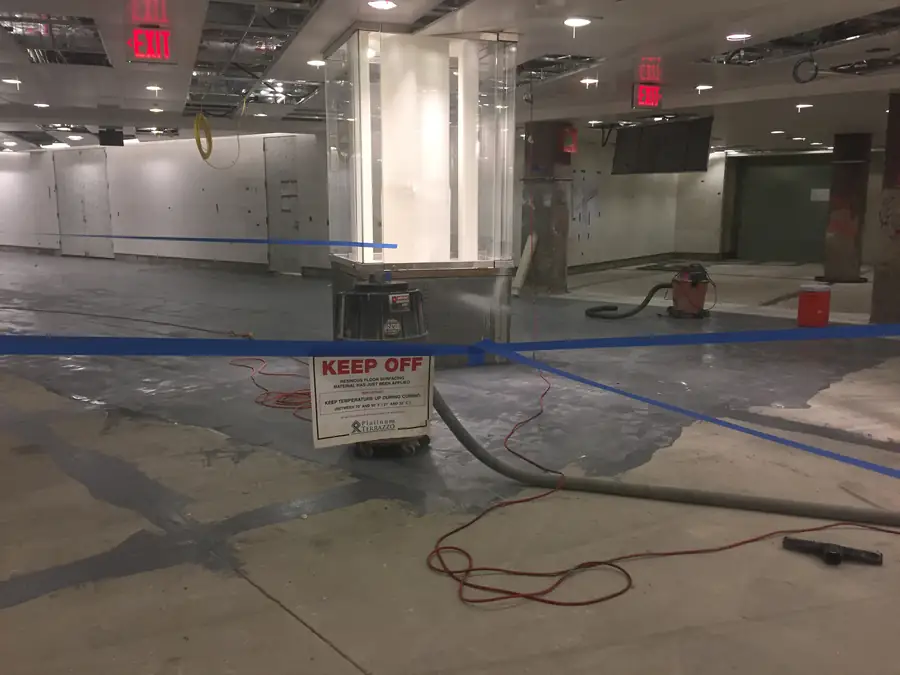
This is not a theoretical rule. Coating crews hang placards on fresh floors that say keep the temperature up during curing, between 70 F and 90 F. That placard exists because leaving a fresh floor to a cold night is how the job goes wrong.
The Bismarck Install Calendar
| Window | Conditions | What gets installed |
|---|---|---|
| Mid May to late September | Frost-free window, warm slabs | Any system. Standard epoxy is at its easiest and cheapest here. Books out first. |
| October to late November | Cooling, variable | Epoxy still workable in heated and attached garages. Unheated buildings move to polyaspartic. |
| Late November to early March | Cold season, highs under 35 F | Polyaspartic in unheated buildings. Epoxy only in a heated space with monitored cure. |
| March to mid May | Thaw and shoulder | Workable and often quiet. Watch for meltwater and a damp slab rather than for cold alone. |
Heated, Tempered and Unheated Garages
Heated attached garage. Shares a wall with the house and usually has a unit heater. These commonly hold a 50 F slab through a full epoxy cure even in January, so the whole product range stays open. Confirm with an infrared reading rather than by feel, because the strip along the overhead door runs colder than the middle of the floor.
Tempered for the job. An unheated building brought up with indirect heat and air movement, held through cure. This works and it costs money: heaters, fuel, containment and monitoring across several days. Priced honestly it is a real line on the quote. If a contractor is proposing a January epoxy install in an unheated garage and there is no heating line on the quote, ask what is holding the temperature.
Unheated, left at ambient. Detached garages, pole barns and shops. From late November to early March these are simply not epoxy candidates. They are polyaspartic candidates or spring bookings, and there is no third answer worth paying for. Polyaspartic coatings →
What the Winter Is Doing to the Slab Meanwhile
While you are waiting for a window, the floor is taking damage, and it is worth understanding the mechanism because it explains where the damage appears.
NDDOT keeps highways passable with pure salt, a salt and sand mix, and a liquid ice-melting material described as a blend of water, salt and a product from sugar beets, effective at temperatures well below zero Fahrenheit. The department's own numbers show why the application rate climbs in a cold snap: one pound of salt melts about 46.3 pounds of ice at 30 F, but only 3.2 pounds at minus 6 F. When salt stops working entirely they switch to scraping and sand for traction.
All of that chloride comes home on the vehicle. It drips into the first eight to ten feet inside the overhead door, sits, freezes as the garage cools overnight and thaws again the next day. Chlorides increase both the number and the severity of those surface freeze-thaw events, so the finished top layer scales off in that band while the back of the garage stays sound. Add Bismarck's 50.5 inches of average annual snowfall and a frost line around four feet and you have a slab under real seasonal stress.
None of that is a reason to rush a bad install. It is a reason to book the right system rather than the convenient one. What the repair looks like if you wait →
Sources
- Euclid Chemical: applying epoxy coatings in cold weather→Manufacturer guidance for the 50 F minimum, the 18 F cure-doubling rule, and material conditioning.
- NDDOT snow and ice control information→What actually goes on North Dakota roads, and how salt effectiveness collapses as temperature drops.
- USDA NRCS Burleigh County→Local soil and site data for anyone looking into what sits under a Burleigh County slab.
Winter Floor Coating Installs in Bismarck ND: Frequently Asked Questions
What is the actual minimum temperature for an epoxy floor in Bismarck?
50 F at the slab, held through the cure, not just at the moment of application. Euclid Chemical states that epoxy coatings are best applied above 50 F and that most epoxies, unless specifically formulated for cold weather, will never fully cure below it. The measurement that matters is the concrete surface temperature taken with an infrared thermometer, not the air temperature, because a slab over ground frozen four feet deep runs colder than the room above it.
How much slower does epoxy cure when it is cold?
It doubles for every 18 F drop below 70 F. Euclid's worked example is an 8 hour cure at 70 F becoming roughly 18 hours at 50 F. Two more 18 degree steps down and you are into days, and below 50 F you are no longer waiting for a slow cure, you are waiting for one that never completes. That is the difference between a floor that is slow and a floor that is ruined.
Which months can floors actually be installed in Bismarck?
Standard epoxy in an unheated building is realistically a mid May to late September job, matching Bismarck's roughly four and a half month frost-free window. Heated attached garages extend that most of the year. Polyaspartic is available year round because it cures at temperatures that stop epoxy. The cold season itself runs about 3.4 months, roughly November 24 to March 4, with average daily highs below 35 F.
Can the garage just be heated for an epoxy install in January?
Sometimes, and it has to be done properly rather than by pointing a torpedo heater at the floor. It means indirect heat with air movement, bringing the slab itself up rather than just the air, conditioning the material in the 70 to 90 F range beforehand, watching the dew point so you are not coating over condensation, and holding the heat through the entire cure. Priced honestly, that adds real cost. Priced dishonestly, it becomes a floor that fails in year two.
Why is road salt such a big deal for a garage floor here?
Because of how much of it there is and where it ends up. NDDOT uses straight salt, salt and sand, and a liquid blend of water, salt and a sugar beet product effective well below zero. Its own figures show one pound of salt melting about 46.3 pounds of ice at 30 F but only 3.2 pounds at minus 6 F, which is why cold snaps mean heavier application. All of it comes home in the wheel wells and drips into the first eight to ten feet inside your garage door.
Does an unheated garage mean I should not bother coating at all?
No, it means the chemistry and the calendar have to match the building. Unheated detached shops and pole barns are a large share of the floors in this market and they benefit more from a coating than heated garages do, because a bare slab in an unheated building takes more freeze-thaw cycling. It just means polyaspartic, or a booking in the warm window, rather than epoxy in February.
Tell Us the Building and the Timeline
Heated or unheated, attached or detached, needed next month or next summer. You will hear which system fits, booked honestly.
Get a Free Quote